
Macrolides and QT-Prolonging Drugs: Understanding the Arrhythmia Risk

Dec, 4 2025
Macrolide QT Risk Calculator
This tool estimates your risk of QT prolongation when taking macrolide antibiotics based on the risk factors identified by the American Heart Association. Remember: risk is influenced by multiple factors, and this tool is for informational purposes only.
Your Risk Factors
What Your Risk Means
This is an estimation based on the factors you selected. Risk levels are determined by the number of risk factors present.
Your Risk Assessment
With no risk factors, the absolute risk of QT prolongation is very low (less than 1 in 100,000).
Key Recommendations
For low-risk individuals: Standard monitoring may be sufficient. Always inform your doctor about all medications.
When you take an antibiotic like azithromycin for a bad cough or clarithromycin for a sinus infection, you’re probably not thinking about your heart. But for some people, these common drugs can quietly disrupt the heart’s electrical rhythm - and in rare but deadly cases, trigger a life-threatening arrhythmia called Torsades de Pointes. This isn’t theoretical. It’s documented in FDA warnings, hospital case reports, and large-scale studies involving millions of patients. The risk is low for most, but it’s real - and it climbs fast when other factors line up.
How Macrolides Mess With Your Heart’s Timing
Macrolides - azithromycin, clarithromycin, and erythromycin - work by stopping bacteria from making proteins. But they also sneak into heart cells and block a key potassium channel called IKr. This channel helps reset the heart’s electrical charge after each beat. When it’s blocked, the heart takes longer to recover. On an ECG, that shows up as a longer QT interval.
That delay might sound minor, but it’s enough to set off a chain reaction. The heart’s cells can fire off abnormal signals called early afterdepolarizations. These can spiral into Torsades de Pointes, a chaotic, twisting rhythm that stops blood from pumping. If not treated fast, it turns into cardiac arrest. The risk isn’t the same across all macrolides. Clarithromycin is the worst offender, blocking IKr more strongly than azithromycin. Erythromycin is in the middle, but it’s rarely used now because of stomach issues. Azithromycin was once thought to be safer - but that changed after a 2012 study in the New England Journal of Medicine found it doubled the risk of heart-related death in high-risk patients.
Who’s Actually at Risk?
Most healthy adults can take azithromycin without a second thought. The baseline risk of Torsades is less than 1 in 100,000. But that number jumps dramatically when other factors pile up. The American Heart Association lists seven major red flags:
- Female sex - women are 2 to 3.5 times more likely to develop TdP
- Age over 65 - aging slows drug clearance and increases sensitivity
- Existing QT prolongation - a QTc over 450 ms in men or 470 ms in women
- Low potassium or magnesium - electrolyte imbalances make the heart more electrically unstable
- Heart failure or structural heart disease - damaged hearts are more prone to rhythm problems
- Other QT-prolonging drugs - taking two or more of these drugs multiplies the risk
- Genetic predisposition - undiagnosed long QT syndrome can turn a routine antibiotic into a trigger
Here’s the scary part: 42% of macrolide prescriptions in cardiac patients in 2022 were paired with at least one other QT-prolonging drug - like certain antidepressants, antifungals, or antiarrhythmics. That’s not an accident. It’s a gap in care. Many doctors don’t check what else their patients are taking.
Real Numbers, Real Cases
The FDA’s adverse event database recorded over 1,800 cases of QT prolongation and nearly 300 cases of Torsades linked to macrolides between 2010 and 2020. Clarithromycin accounted for 58% of those events - even though it’s only used in about 15% of macrolide prescriptions. Why? Because it’s the most potent blocker of IKr. A 2021 case series of 12 patients with confirmed TdP found that 9 had at least two additional risk factors: low potassium, heart disease, or another drug on board.
One real-world example: a 72-year-old woman with mild heart failure and low potassium takes clarithromycin for pneumonia. She’s also on a common diuretic and a statin - both of which can lower potassium. She doesn’t have an ECG before starting the antibiotic. Three days later, she collapses. She survives, but only because her family called 911 fast. Her QTc was 580 ms. That’s not a borderline result. That’s a warning light flashing red.

The Azithromycin Debate
Why is there so much disagreement about azithromycin? Because the early studies were messy. The 2012 Ray study that sparked the FDA warning compared azithromycin to amoxicillin - but didn’t fully account for why people were getting azithromycin in the first place. People prescribed azithromycin were often sicker: older, with more infections, more comorbidities, more medications. When researchers went back and adjusted for 108 variables - including smoking, diabetes, kidney function, and prior heart issues - the increased death risk dropped to almost zero.
But here’s the catch: even if azithromycin isn’t the direct cause, it’s still the last straw. In a person with five risk factors, adding azithromycin can be enough to push them over the edge. The European Heart Rhythm Association puts the absolute risk of TdP at just 3 to 7 cases per million treatment courses. That’s rare. But rare doesn’t mean impossible - and when it happens, it’s often fatal.
What Doctors Should Do - And What They Often Don’t
There’s a clear, evidence-based path forward. The AHA’s 2020 guidelines say: screen, swap, or monitor.
- Screen - Check for the seven risk factors before prescribing. Ask about heart history. Check electrolytes if the patient is on diuretics or has kidney disease. Look at their ECG if available.
- Swap - For high-risk patients, choose an antibiotic with no QT risk. Doxycycline works for many respiratory infections. Amoxicillin is still first-line for most. Even a non-antibiotic like a nasal steroid might be enough for sinus congestion.
- Monitor - If you must use a macrolide in someone with moderate risk, get a baseline ECG and repeat it after 3-5 days. Check potassium levels. Avoid IV doses if possible - they cause higher peak concentrations.
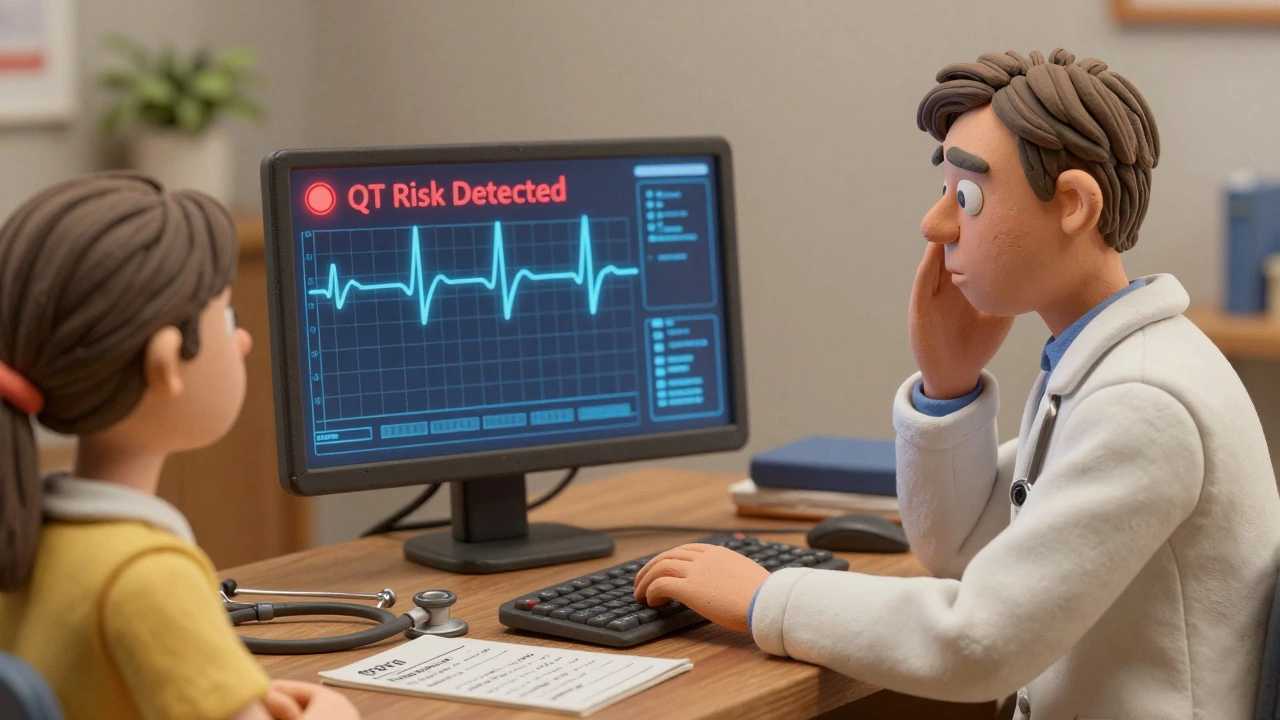
But here’s the problem: most clinics don’t have tools to do this automatically. Electronic health records rarely flag drug interactions or QT risks. Only 62% of physicians surveyed in 2023 said they routinely check potassium levels before prescribing macrolides to older patients. The rest wait for symptoms - which is too late.
What’s Changing - And What’s Coming
Some hospitals are fixing this. Kaiser Permanente added automated alerts to their EHR in 2017. If a doctor tried to prescribe clarithromycin to a patient with a QTc over 500 ms, the system blocked it and suggested alternatives. Result? High-risk prescriptions dropped by 28% in two years.
Newer antibiotics are being designed to avoid this problem. Solithromycin, a ketolide, showed no QT prolongation in trials. But the FDA rejected it in 2016 because of liver toxicity. It’s a reminder: every drug has trade-offs. The goal isn’t to ban macrolides - it’s to use them smarter.
By 2027, clarithromycin use in cardiac patients is expected to drop another 15-20%. Azithromycin will stay popular, but more cautiously. The real win won’t be a new drug. It’ll be better screening, better communication, and doctors asking one simple question before writing a prescription: What else is this patient taking - and what’s their heart doing?
What You Can Do
If you’re prescribed a macrolide and you’re over 65, have heart disease, or take other medications - ask your doctor:
- “Is this the safest antibiotic for me, given my other meds and health?”
- “Could this affect my heart rhythm?”
- “Should I get an ECG before starting this?”
- “Can we check my potassium and magnesium levels?”
Don’t assume it’s safe because it’s common. Don’t assume your doctor knows everything you’re taking. Bring a list of all your medications - including supplements and over-the-counter drugs. Many QT-prolonging drugs are hidden in cold medicines, antacids, or antidepressants.
And if you’ve ever had a fainting spell, unexplained seizures, or a family history of sudden cardiac death before age 50 - tell your doctor. You might have undiagnosed long QT syndrome. A simple ECG could save your life.


