
In Vivo vs In Vitro Bioequivalence Testing: When Each Is Used
Feb, 11 2026
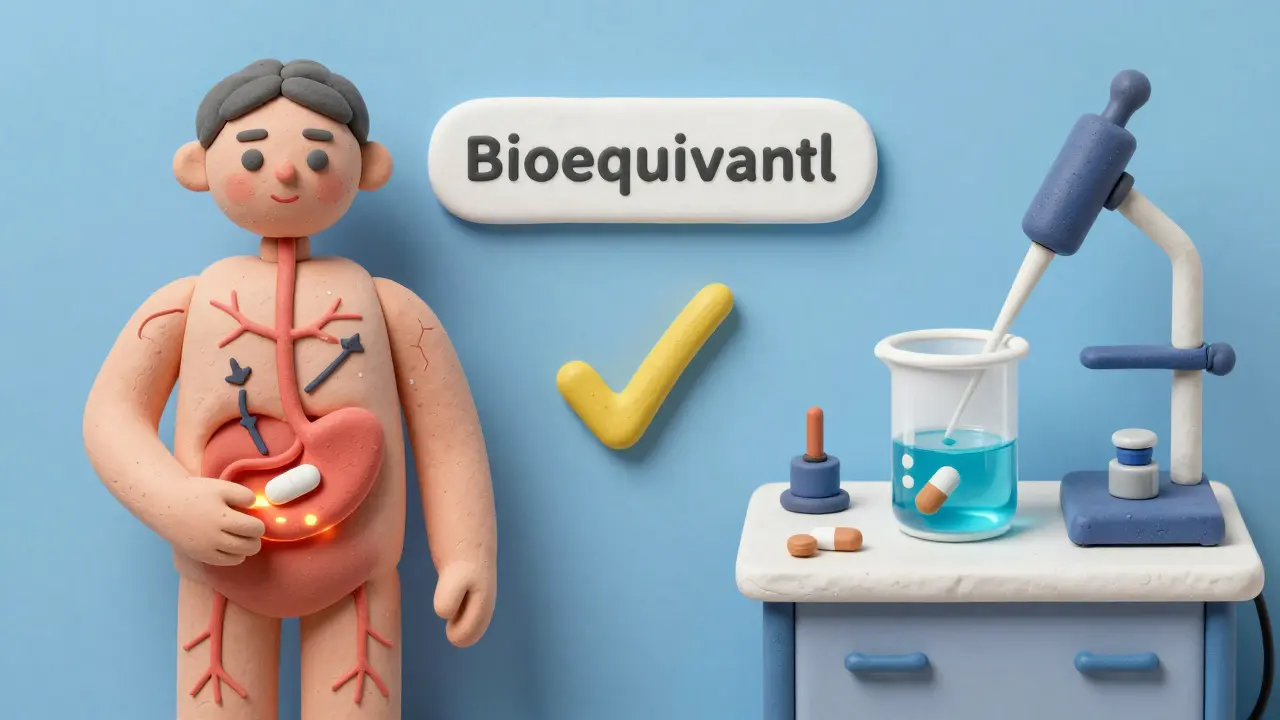
When a company wants to sell a generic version of a drug, they don’t just copy the pill and call it done. They have to prove it works the same way in the body. That’s where bioequivalence testing comes in. But there are two main ways to do it: in vivo and in vitro. One tests on people. The other tests in a lab. Which one you use depends on the drug, how it’s made, and what regulators will accept.
What is bioequivalence testing, and why does it matter?
Bioequivalence testing is the gold standard for proving that a generic drug performs just like the brand-name version. It’s not about matching ingredients - it’s about matching how the body absorbs and uses the drug. The FDA requires that the amount of drug in your bloodstream (measured as AUC) and how fast it gets there (measured as Cmax) must be within 80% to 125% of the original product. If it’s outside that range, the generic might not work as well - or could even be dangerous.
This isn’t just bureaucracy. For drugs like warfarin or levothyroxine, even small differences in absorption can lead to serious side effects. That’s why regulators don’t just trust the label. They need hard evidence.
In vivo testing: The human trial approach
In vivo bioequivalence testing means testing on real people - usually 24 healthy volunteers. These studies follow a strict crossover design: one group takes the generic first, then the brand after a washout period. The other group does the reverse. Blood samples are taken over 24-72 hours to track how the drug moves through the body.
This method is considered the most reliable because it captures everything that happens inside a living person: stomach acid, gut movement, liver metabolism, food effects. If a drug is affected by eating, the study includes both fasting and fed-state tests.
But it’s expensive. A single in vivo study costs between $500,000 and $1 million. It takes 3-6 months from start to finish. You need certified clinical sites, trained staff, and compliance with 21 CFR Part 11 for electronic records. And ethically, you’re asking healthy people to take drugs for science.
Despite the cost, in vivo testing still makes up 95% of generic drug approvals for oral tablets. It’s the fallback when anything else is too uncertain.
In vitro testing: Lab-based precision
In vitro testing skips the human body entirely. Instead, scientists use machines to simulate how the drug behaves outside the body. The most common method is dissolution testing - dropping a pill into a liquid that mimics stomach or intestinal fluid and measuring how fast it breaks down.
But there’s more. For inhalers, they test droplet size with laser diffraction. For nasal sprays, they use cascade impactors to measure how particles settle in the nose. For topical creams, they test how the drug moves through a membrane. These methods are precise, repeatable, and cost far less - often under $150,000 and done in 2-4 weeks.
The coefficient of variation (CV) for in vitro tests is typically under 5%, compared to 10-20% for human studies. That means less noise, more clarity. If two products dissolve differently in a test tube, they likely behave differently in the body.

When does in vitro testing work?
In vitro methods aren’t magic. They only replace human studies when there’s strong evidence linking lab results to real-world performance. The FDA accepts them in four main cases:
- BCS Class I drugs - drugs that are highly soluble and highly permeable. These include common meds like atorvastatin, metformin, and ciprofloxacin. In 2021, 78% of biowaivers for these drugs were approved based on in vitro data alone.
- Topical products - creams, ointments, or gels that act on the skin. Since they don’t enter the bloodstream, measuring plasma levels doesn’t make sense. Instead, dissolution and particle size are used.
- Inhalers and nasal sprays - because you can’t easily measure lung deposition in humans, regulators rely on cascade impactor data and dose delivery measurements. In 2022, Teva’s generic budesonide nasal spray became the first to get approval based solely on in vitro testing.
- When IVIVC is proven - that’s in vitro-in vivo correlation. If you’ve built a mathematical model that predicts how dissolution rates in the lab match up with blood concentration in people, regulators will accept it. This is common for extended-release tablets, like theophylline.
For these cases, in vitro testing isn’t just convenient - it’s smarter. It catches manufacturing flaws early. A batch of pills that dissolves too slowly? You’ll find it before it ever reaches patients.
When do you need in vivo testing?
Even with advances in lab science, in vivo testing is still required in several high-risk situations:
- Narrow therapeutic index drugs - like digoxin, cyclosporine, or lithium. Here, the acceptable range shrinks to 90-111%. The FDA won’t trust anything less than human data.
- Drugs with food effects - if eating changes absorption (like with griseofulvin), you need both fasting and fed studies.
- Nonlinear pharmacokinetics - where higher doses don’t lead to proportionally higher blood levels. This happens with some antifungals and antivirals.
- BCS Class III and IV drugs - drugs that don’t dissolve well or can’t cross cell membranes. In vitro methods fail here. A 2018 study showed in vitro tests correctly predicted bioequivalence for only 65% of these drugs.
- When no IVIVC exists - if you can’t prove your lab test matches real human absorption, regulators won’t accept it.
There’s also a practical reality: companies sometimes use in vitro testing to get approval faster, only to be hit later with a post-marketing in vivo study. One company saved $1.2 million on a generic tablet using in vitro testing - but had to spend $850,000 later when patients reported side effects. That’s the hidden cost of cutting corners.

Regulatory trends: The shift toward in vitro
The FDA, EMA, and other agencies are pushing hard to expand in vitro testing. Why? Because it’s faster, cheaper, and more ethical. The FDA’s 2020-2025 plan explicitly says it wants to use “model-informed approaches” more often.
In 2022, the EMA approved 214 biowaivers based on in vitro data - up 27% from 2020. The FDA approved its first fully in vitro nasal spray in October 2022. By 2025, they plan to release two new guidances on in vitro testing for complex products like inhalers and injectables.
Even better, tools like physiologically based pharmacokinetic (PBPK) modeling are helping bridge the gap. These computer simulations predict how a drug behaves in the body based on its chemistry, anatomy, and physiology. The FDA now accepts PBPK models for certain extended-release products.
The future? A hybrid system. For most simple oral drugs, in vitro will be the norm. For high-risk drugs - or when there’s uncertainty - in vivo will still be the backup.
What’s the bottom line?
There’s no one-size-fits-all answer. If you’re making a generic version of a common pill like ibuprofen or amoxicillin, in vitro testing is likely your best bet. It’s reliable, fast, and saves millions.
But if you’re working with a drug that’s tricky to absorb, has a narrow safety window, or acts in a complex part of the body - don’t skip the human study. The risk isn’t worth it.
Regulators aren’t against innovation. They just want proof - real, repeatable, and reliable. Whether that comes from a test tube or a volunteer’s blood sample, the goal is the same: make sure the generic works just like the brand.


