
Using Copay Cards Safely: Access Without Compromising Care

Jan, 19 2026
Copay Accumulator Impact Calculator
Calculate Your Copay Card Impact
Understand how copay accumulator programs affect your deductible and out-of-pocket costs.
Results
Enter your values and click 'Calculate Impact' to see how copay accumulator programs affect your costs.
When you’re managing a chronic illness like multiple sclerosis, rheumatoid arthritis, or Crohn’s disease, your medication isn’t just a pill-it’s your lifeline. For many, that lifeline comes with a price tag of $5,000 to $10,000 a month. That’s where copay cards come in. They’re offered by drug manufacturers to help people with commercial insurance pay less out of pocket. But here’s the catch: using them without understanding how they work can leave you stranded when the card runs out.
What Copay Cards Actually Do
Copay cards are free vouchers from pharmaceutical companies that cover part of your prescription cost. If your insurance says you owe $800 for a monthly drug, the card might pay $700, leaving you with just $100. Sounds great, right? For millions of people, it is. According to a 2023 NIH study, 93% of patients using these cards say they’ve made a real difference in sticking with their treatment. But there’s a hidden rule: these cards only work if you have private health insurance. They don’t work for Medicare, Medicaid, or anyone on government programs. That’s not a glitch-it’s federal law. The anti-kickback statute blocks drugmakers from directly subsidizing public insurance patients, so the cards are legally restricted to those with employer-sponsored or individually purchased plans.The Silent Trap: Copay Accumulator Programs
Here’s where things go wrong. Since 2016, most major insurers-UnitedHealthcare, Cigna, Aetna, and others-have started using something called a copay accumulator program. What that means is simple: the money from your copay card doesn’t count toward your deductible or out-of-pocket maximum. It disappears into a black hole. Let’s say your plan has a $7,000 deductible. You’ve paid $1,000 so far this year. Your drug costs $7,500 a month. Your copay card covers $7,000 of it, so you pay $500. Under normal rules, that $7,000 from the card would count toward your deductible. You’d be halfway there after one month. But with an accumulator program? That $7,000 doesn’t count. Your deductible stays at $1,000. You pay $500 a month for 12 months. When your card expires after $20,000 in total assistance, you’re suddenly facing the full $7,000 monthly cost-with your deductible still untouched. You’ve paid $6,000 out of pocket, and now you owe $7,000 more just to hit your deductible. Many patients stop treatment. Some go bankrupt. Others wait months for help. A 2021 study published in the Journal of the American Medical Association found that patients under accumulator programs were 23.4% more likely to quit their meds. That’s not a small risk. That’s life-threatening.What’s Even Worse: Copay Maximizers
Some insurers don’t just block the card’s value-they flip it. They use what’s called a copay maximizer program. In this version, the insurer calculates the maximum amount the card can cover, then sets your copay to exactly that amount. So if the card can pay up to $7,000, you pay $7,000… but the insurer says you didn’t pay anything. Your deductible doesn’t move. Your out-of-pocket maximum stays the same. You’re paying nothing now, but you’re not building any protection for the future. It looks like a win-until you need surgery, an ER visit, or another expensive treatment. Then you realize you’re still at $0 toward your deductible. You’re paying full price for everything else, too.
How to Use Copay Cards Without Getting Hurt
You don’t have to be a victim of this system. There are steps you can take to protect yourself. Ask these three questions before you use a copay card:- Does my insurance plan have a copay accumulator or maximizer program?
- How much of my deductible and out-of-pocket maximum have I already met this year?
- What happens when this card runs out? Will I be on the hook for the full price?
Watch for Alerts and Plan Ahead
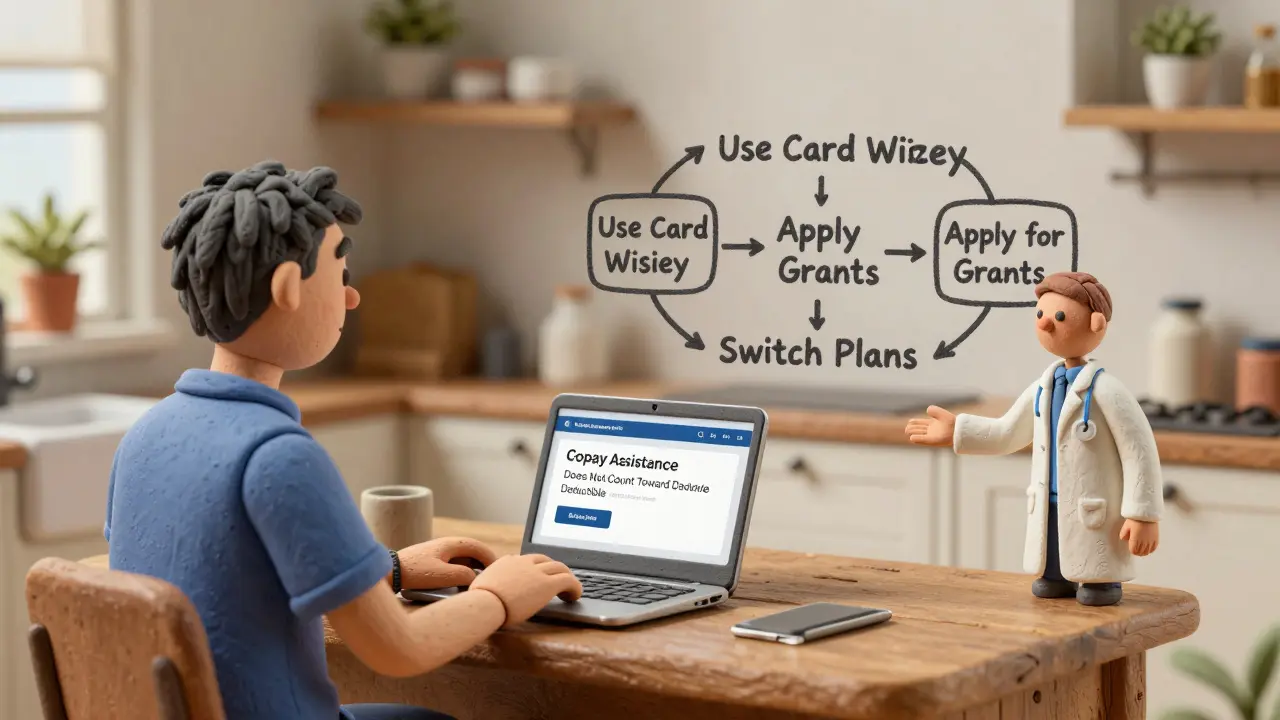
Most copay cards last 12 to 24 months. Some have annual limits of $5,000 to $25,000. You need to know when it’s running out. Some specialty pharmacies now send out “accumulator alerts” when you’ve used 80% of your card’s value. That gives you two months to find a backup plan. What’s your backup? Here’s what works:- Ask your drugmaker if they have a patient assistance program for when the card ends. Many do.
- Check nonprofit organizations like the Patient Access Network Foundation or the Chronic Disease Fund. They give grants for high-cost meds.
- Ask your doctor about generic alternatives or lower-cost therapies-even if they’re not your first choice, they might be better than stopping treatment.
- If you’re on a high-deductible plan, consider switching to a plan without an accumulator program next year. They’re still out there.
The Bigger Picture: Why This Is Happening
You might wonder: why are insurers doing this? The answer is messy. Insurers say they’re fighting inflated drug prices. They argue that if manufacturers pay your copay, it hides the real cost of the drug, making it harder to negotiate lower prices. Some experts agree. But here’s what the data shows: the Congressional Budget Office found that accumulator programs actually increased total drug spending by 4.2% per year. Why? Because patients stop taking their meds, then end up in the hospital. ER visits, emergency treatments, and disease flare-ups cost far more than the drug itself. Drugmakers, on the other hand, spend $21.3 billion a year on copay cards. That’s 18.7% of their net revenue from specialty drugs. They’re not doing it out of charity. It’s a business strategy: get patients hooked on the drug, then lock them in. But that doesn’t make the patient risk any less real.What’s Changing in 2026
Good news: things are starting to shift. On January 1, 2026, a new federal rule kicks in. Insurers must now clearly tell you during enrollment if they use accumulator or maximizer programs. They also have to send you a monthly statement showing your true progress toward your deductible-even if the card payments don’t count. That’s huge. For the first time, patients will know what’s happening. No more surprises. Some insurers are already adapting. CVS Caremark launched “transparency dashboards” that show real-time deductible progress. But right now, only 28% of commercially insured Americans have access to these tools. Meanwhile, Congress is considering the Copay Accumulator Moratorium Act. It would ban these programs for three years while researchers study their impact. It has 72 bipartisan supporters. The drug industry is spending millions to stop it.What You Can Do Today
Don’t wait for policy changes. Protect yourself now.- Call your insurer and ask about accumulator programs. Get it in writing.
- Ask your pharmacist to check your plan’s status every time you refill.
- Track your card’s expiration date and remaining balance.
- Start exploring backup options before your card runs out.
- If you’re already stuck, talk to your doctor. There may be other ways to get help.
Can I use a copay card if I’m on Medicare or Medicaid?
No. Federal law prohibits pharmaceutical companies from offering copay cards to patients enrolled in Medicare, Medicaid, or other government-funded health programs. This is due to the Anti-Kickback Statute, which prevents drugmakers from influencing patient choices through financial incentives for public insurance. If you’re on Medicare or Medicaid and need help paying for expensive medications, you may qualify for patient assistance programs offered directly by drug manufacturers or nonprofit organizations.
How do I know if my insurance has a copay accumulator program?
Call your insurance company’s member services line and ask: “Does my plan use a copay accumulator or maximizer program for specialty medications?” Request a written confirmation via email or letter. You can also check your plan documents under “cost-sharing” or “out-of-pocket maximum” sections. Many insurers now include this information in their online portals under “benefits summary.” If they don’t mention it, assume they do-it’s becoming the default.
What happens when my copay card expires?
If your plan uses an accumulator program, your deductible and out-of-pocket maximum may still be at zero-even if you’ve paid thousands in copays. Once the card runs out, you’ll owe the full price of your medication until you meet your deductible. This can mean a sudden jump from $50 to $7,000 per month. Plan ahead: contact your drugmaker’s patient support team, apply for nonprofit grants, or talk to your doctor about alternatives before your card ends.
Are copay cards worth it if my plan has an accumulator program?
Yes-if you use them wisely. If you only need the medication for a short time (like a 12-month course), or if you can complete your treatment before the card expires, it’s still a huge benefit. But if you need long-term therapy, the card may leave you financially exposed afterward. Use it as a bridge, not a permanent solution. Always pair it with a backup plan.
Can I switch insurance plans to avoid accumulator programs?
Yes, during open enrollment or if you experience a qualifying life event like a job change. Some employer plans and individual marketplace plans still don’t use accumulator programs. Ask potential insurers directly before signing up. Look for plans that explicitly state “copay assistance counts toward your out-of-pocket maximum.” These are rare but still available, especially in fully insured plans (not self-insured employer plans).
What should I do if I’ve already stopped my medication because of a copay card surprise?
Contact your doctor immediately. Don’t wait. Many drug manufacturers have emergency patient assistance programs for people who’ve lost coverage. Nonprofits like PAN Foundation and HealthWell Foundation can provide grants to cover your medication while you navigate your options. Also, ask your pharmacist about drug samples or temporary discounts. Stopping treatment can lead to serious health setbacks-don’t delay getting help.


