
SSRIs and Anticoagulants Together: What You Need to Know About Bleeding Risk
Jan, 13 2026
Bleeding Risk Calculator for SSRI and Anticoagulant Patients
Understand Your Risk
When taking both an SSRI and an anticoagulant, your bleeding risk increases significantly. This tool calculates your HAS-BLED score, a validated tool that assesses bleeding risk based on key factors. Scores of 3 or higher indicate increased risk.
HAS-BLED Risk Assessment
Select the factors that apply to you. Each factor adds 1 point to your score.
Combining SSRIs with anticoagulants isn’t rare - it’s common. About 1 in 5 people on blood thinners also have depression or anxiety and are prescribed an SSRI. But here’s the thing: this combo isn’t harmless. It raises your risk of serious bleeding - and most people don’t know it.
Why This Combination Is Risky
SSRIs like sertraline, escitalopram, and fluoxetine work by boosting serotonin in the brain. But serotonin isn’t just a mood chemical. It’s also stored in platelets, the tiny blood cells that help clots form. When SSRIs block serotonin reuptake in the brain, they do the same thing in platelets. That means platelets run out of serotonin, and without it, they can’t stick together properly to stop bleeding. This isn’t theory. Studies show SSRIs reduce platelet serotonin by up to 90% at normal doses. That leads to a 30-40% drop in platelet aggregation. In plain terms: your blood doesn’t clot as well. Add that to a blood thinner like warfarin or apixaban, and you’re stacking two forces that slow clotting. The result? A 33% higher chance of major bleeding compared to using the blood thinner alone.Where the Bleeding Happens
It’s not random. Most bleeding from this combo shows up in the same places:- Gastrointestinal bleeding - 58% of cases. Think black stools, vomiting blood, or unexplained anemia.
- Intracranial hemorrhage - 17% of cases. That’s bleeding in the brain. Even a small bleed here can be life-changing.
- Other major bleeding - 25% of cases. This includes muscle bleeds, joint bleeds, or unexplained bruising.
Not All Blood Thinners Are the Same
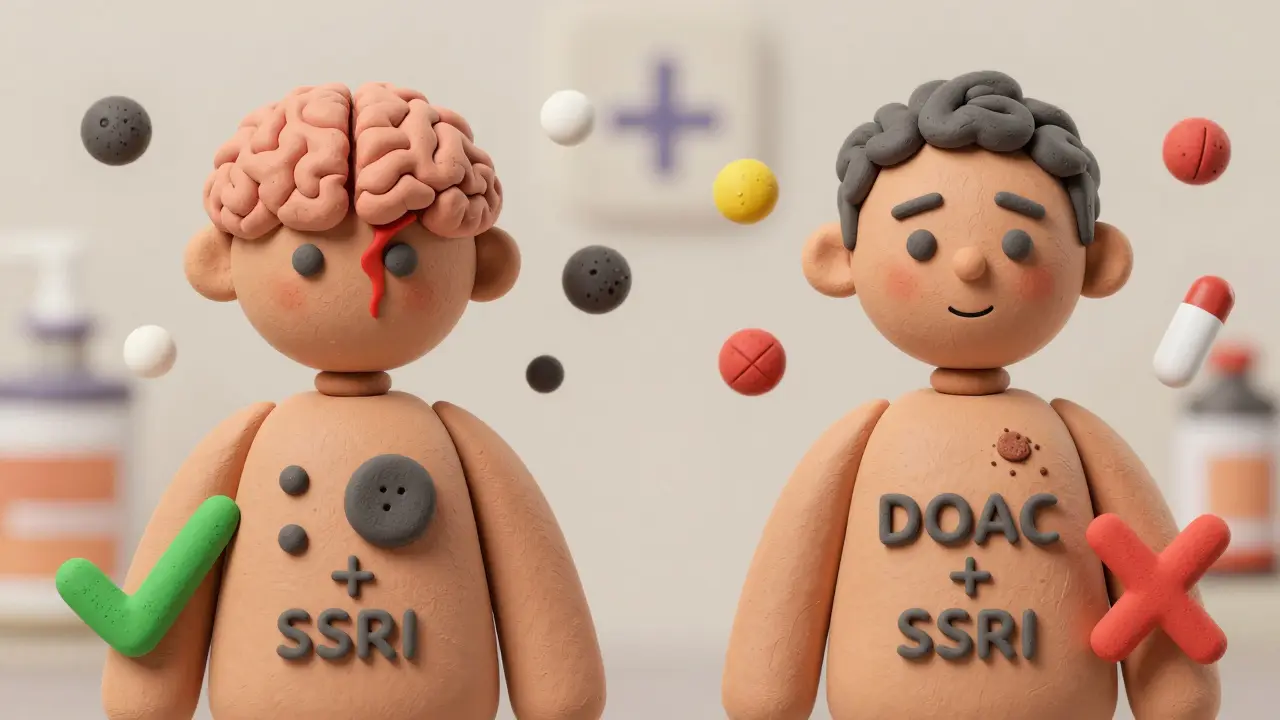
The risk isn’t the same across all anticoagulants. Warfarin, the older type, carries a higher risk when mixed with SSRIs than the newer direct oral anticoagulants (DOACs) like rivaroxaban or dabigatran. A 2024 study of over 42,000 patients found:- Warfarin + SSRI: 28% higher bleeding risk
- DOAC + SSRI: 22% higher bleeding risk
Not All SSRIs Are the Same Either
You might think stronger SSRIs - like paroxetine - are riskier. But that’s not what the data shows. The same 2024 study found paroxetine, escitalopram, and sertraline all carried the same bleeding risk. Even though paroxetine blocks serotonin reuptake more tightly, it didn’t lead to more bleeding. Sertraline is still the most commonly prescribed SSRI in this group - not because it’s safest, but because it has fewer drug interactions with other medications. If you’re on multiple drugs, your doctor might pick sertraline just to keep things simple.The First 30 Days Are the Danger Zone
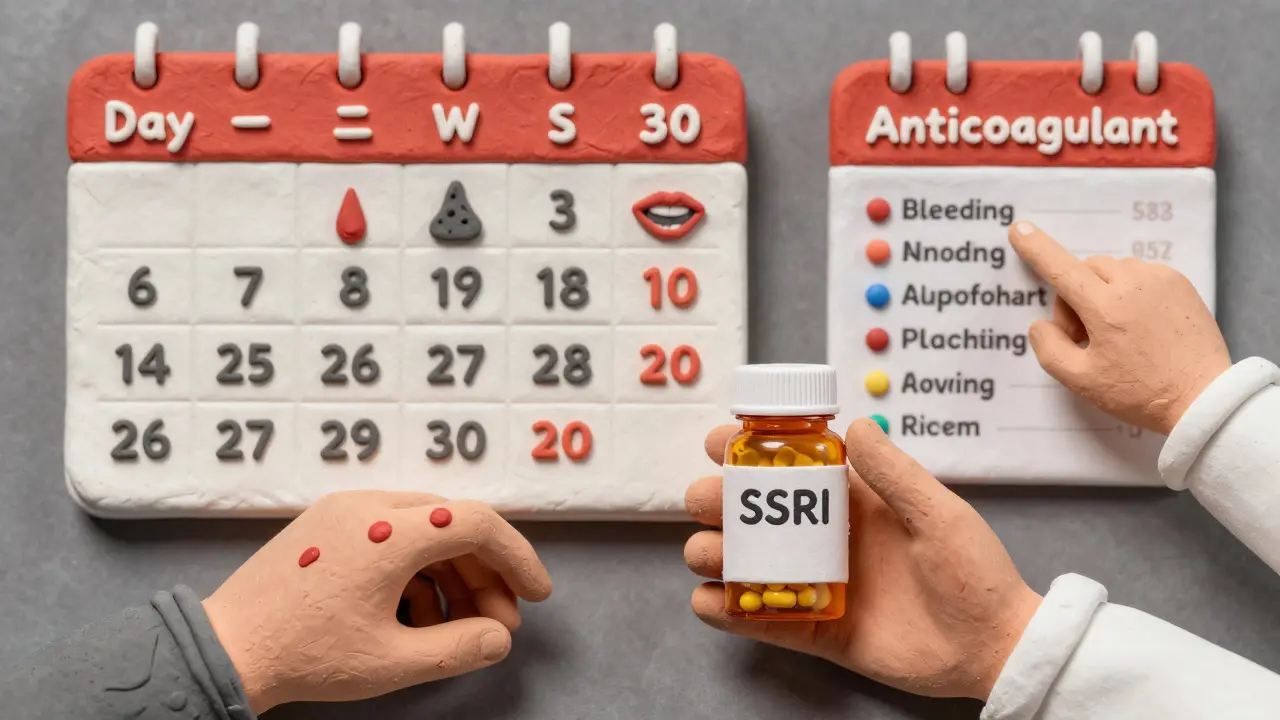
The biggest spike in bleeding risk doesn’t happen after months. It happens in the first month. The 2024 study showed the 33% increased risk is strongest during the first 30 days of starting both drugs together. After six months, the risk drops significantly. Why? Your body adapts. Platelet turnover replaces old, serotonin-depleted cells with new ones. But in those first weeks, your clotting system is at its weakest. That’s why doctors are told to watch closely during this time. If you’re just started on both meds, look out for:- Unusual bruising
- Red or dark stools
- Bleeding gums
- Headaches, dizziness, or confusion (possible brain bleed)
- Excessive bleeding from cuts
What Should You Do?
If you’re on a blood thinner and your doctor suggests an SSRI, here’s what to ask:- Is this SSRI really necessary? Could therapy or a different antidepressant work? Mirtazapine and bupropion don’t affect platelets and are safer alternatives.
- Are we using a DOAC instead of warfarin? If not, why? DOACs are safer with SSRIs.
- What’s my bleeding risk score? The HAS-BLED score looks at things like high blood pressure, kidney disease, and age. If your score is 3 or higher, your risk is elevated. That might mean choosing a non-SSRI antidepressant.
- What monitoring will happen? Expect blood tests (CBC, fecal occult blood) every month for the first three months. If you’re on warfarin, INR checks may need to happen twice a week at first.
What’s New in 2025?
The FDA updated its warning labels in January 2025. Now, anticoagulant medication guides explicitly say: “Consider non-SSRI antidepressants in patients with additional bleeding risk factors.” A new study from January 2025 confirmed SSRIs don’t interfere with the actual clotting cascade - they don’t affect thrombin or fibrin formation. The problem is purely platelet-related. That’s important because it means other drugs that affect clotting (like NSAIDs) can make things even worse. And there’s more on the horizon. The PRECISION-AF trial, tracking 5,000 patients on blood thinners with depression, is comparing SSRIs to non-SSRI antidepressants. Results are due in late 2026. That could change guidelines for good.Bottom Line
This isn’t a reason to avoid SSRIs. Depression is serious. Untreated, it kills - often faster than bleeding. But it’s also not a risk you should ignore. SSRIs and anticoagulants together are a moderate-risk combo. Not dangerous for everyone. But dangerous enough that you need to be proactive. If you’re on both, make sure:- Your doctor knows you’re taking both
- You’re on a DOAC if possible
- You’re monitored closely in the first month
- You know the signs of bleeding
- You’re not taking NSAIDs like ibuprofen or naproxen
Can I take ibuprofen with an SSRI and a blood thinner?
No. Ibuprofen and other NSAIDs like naproxen also affect platelets and increase bleeding risk. Combining them with SSRIs and anticoagulants can triple your risk of major bleeding. Use acetaminophen (paracetamol) for pain instead - it doesn’t affect clotting.
Are there antidepressants that don’t increase bleeding risk?
Yes. Mirtazapine and bupropion don’t interfere with platelet serotonin. They’re often recommended for people on blood thinners who need an antidepressant. They may be less effective for some types of depression, but they’re much safer when bleeding risk is a concern.
How often should I get blood tests if I’m on both meds?
If you’re on warfarin, expect INR checks twice a week for the first month, then every 2-4 weeks. For DOACs, no routine INR is needed. But you should still get a complete blood count (CBC) and fecal occult blood test at baseline and monthly for the first three months. After that, every 3-6 months unless symptoms appear.
Is this risk higher in older adults?
Yes. People over 65 have a higher baseline risk of bleeding. Their platelets are less responsive, their stomach lining is more fragile, and they’re more likely to have other conditions like high blood pressure or kidney disease. The combination is especially risky in this group. Doctors should be extra cautious and consider alternatives.
What if I need surgery or a dental procedure?
Don’t stop your meds without talking to your doctor. Stopping an anticoagulant can cause a stroke. Stopping an SSRI can trigger withdrawal or worsen depression. Instead, tell your surgeon or dentist you’re on both. They may adjust timing, use local hemostatic agents, or delay the procedure. Never make changes on your own.


