
Manufacturer Reporting: Understanding Generic Safety Obligations for Companies
Dec, 17 2025
When a medical device fails, a toy breaks, or a car part malfunctions, the consequences can be deadly. But what happens after the incident? Who’s responsible for telling the government? The answer lies in manufacturer reporting - a legal requirement that forces companies to disclose safety problems before more people get hurt. This isn’t optional. It’s not a suggestion. It’s a federal mandate with real penalties, and every company that makes products sold in the U.S. needs to know exactly what it means.
What Exactly Do Manufacturers Have to Report?
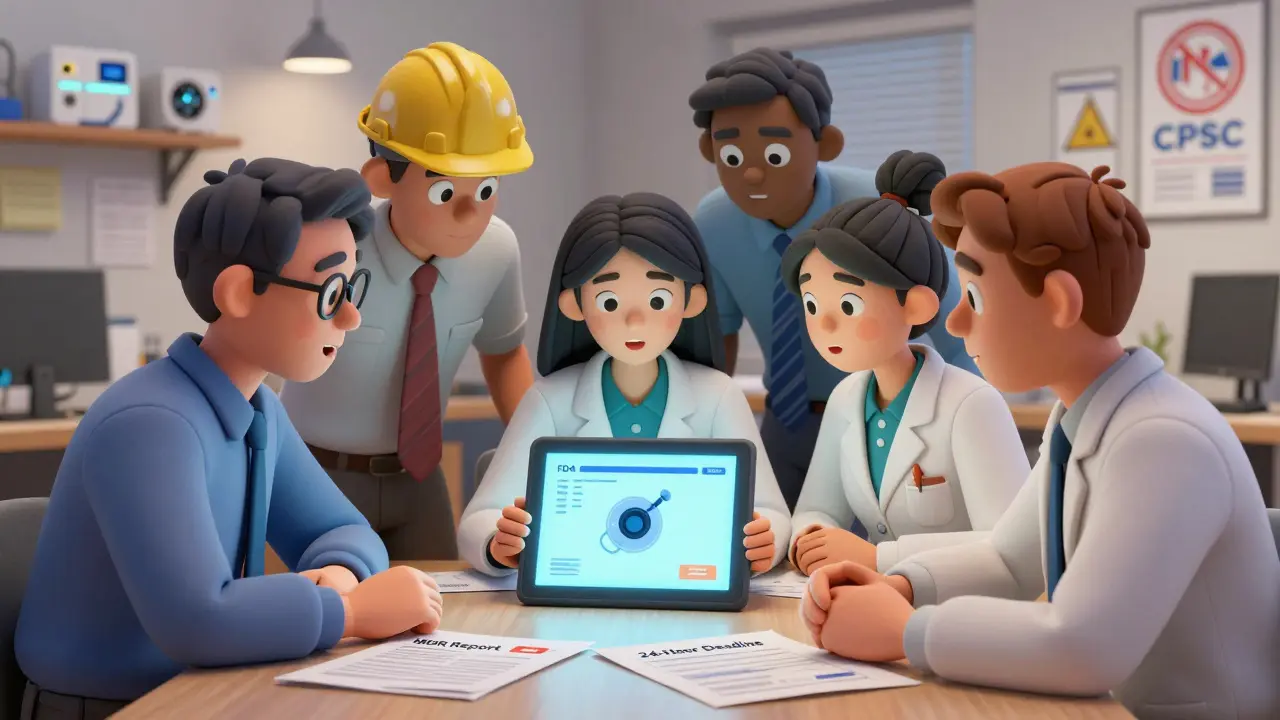
It depends on the product. There’s no single rule that covers everything. Instead, different agencies enforce different rules based on what’s being made.For medical devices - things like pacemakers, insulin pumps, or surgical tools - the FDA requires manufacturers to report any incident that may have caused or contributed to a death, serious injury, or a malfunction that could cause harm if it happened again. That’s called the Medical Device Reporting (MDR) system, under 21 CFR Part 803. The clock starts ticking the moment someone in the company becomes aware of the issue. That could be a customer service rep, a technician, or even a salesperson who hears a complaint. Once they know, the reporting obligation kicks in.
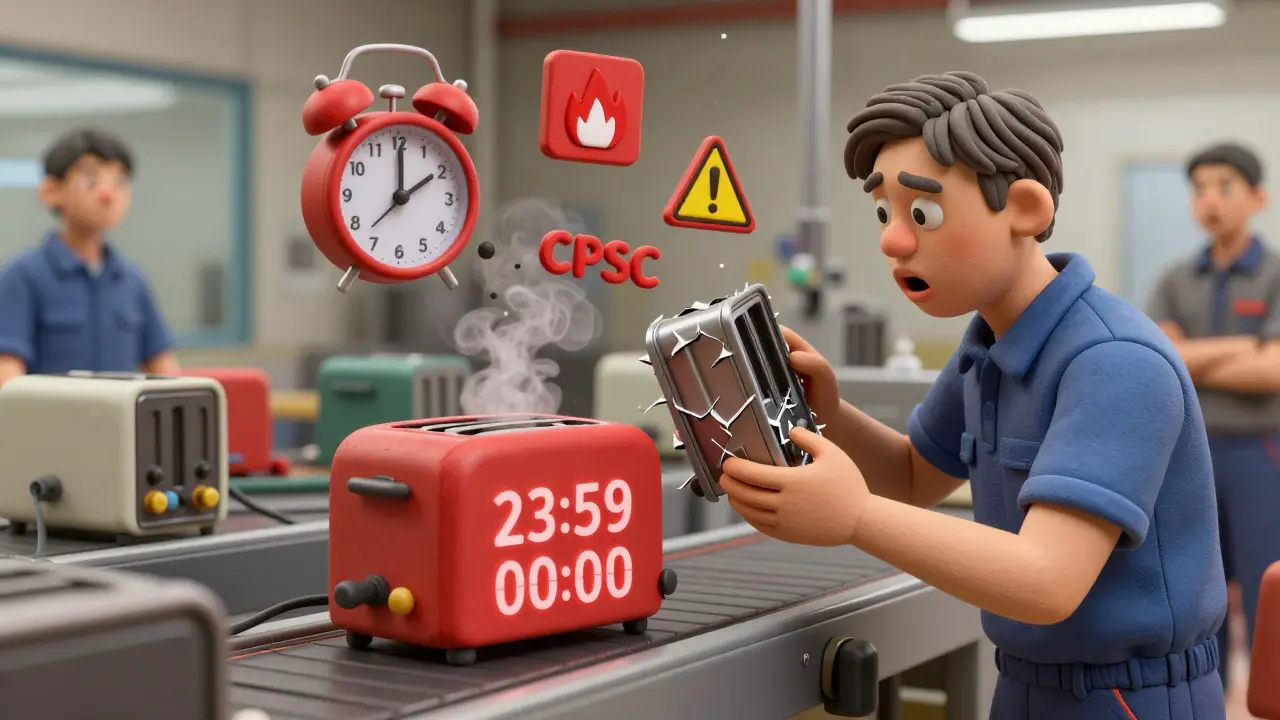
For general consumer products - think toasters, cribs, or power tools - the Consumer Product Safety Commission (CPSC) demands reporting within 24 hours of getting ‘reportable information.’ That doesn’t mean waiting for an injury to happen. If you find out your product has a design flaw that could seriously hurt someone, you have to tell the CPSC. Even if no one’s been hurt yet. The law doesn’t wait for tragedy to strike.
And for vehicles and auto parts, the National Highway Traffic Safety Administration (NHTSA) runs its own system. Tire makers, for example, must report if they get word of five or more deaths, ten or more injuries, or ten or more property damage claims tied to a single tire model. It’s not about one bad tire. It’s about patterns.
Timing Isn’t Just Important - It’s Legal
Deadlines are strict, and missing them isn’t an excuse. The FDA gives you 30 calendar days to report deaths or serious injuries from medical devices. But if the problem requires immediate action - like a recall or repair - you have just five working days. That’s less than a week to investigate, document, and file. Many companies struggle with this. One quality manager in Ohio told us her team spent over 1,200 hours a year just on MDR paperwork. That’s more than half a full-time job.The CPSC is even tighter. Twenty-four hours. No extensions. No grace period. If you find out on Monday at 3 p.m. that your blender’s blade can fly off under normal use, you have until Tuesday at 3 p.m. to submit your report. And if you miss it? The CPSC can fine you up to $252,756 per violation - adjusted for inflation in 2024. In 2023, 54% of home appliance manufacturers got warning letters from the CPSC for late reporting. That’s more than half.
Why so strict? Because every hour counts. A faulty heart monitor might kill one person this week. If no one reports it, the same device kills five more next month. The system is built to catch problems early - before they become epidemics.
It’s Not Just About Filing Forms
Reporting isn’t just clicking ‘Submit’ on a government website. It’s a full process. The FDA requires manufacturers to have written procedures for handling complaints, investigating every report, and keeping records for at least two years after the device is last sold. You need to prove you looked into it. You need to show your findings. You need to document why you did or didn’t report it.That means training staff. Setting up internal systems. Creating workflows. Many companies hire dedicated compliance officers just to handle this. Small businesses with fewer than 50 employees spend an average of $50,000 a year - and 18.7% of their entire quality department budget - just to stay compliant.
And it’s not cheap to build the infrastructure. A basic quality management system (QMS) for a small manufacturer costs around $185,000. For larger companies, it’s over $750,000. You also need IT support to file electronically. The FDA only accepts reports through its Electronic Submission Gateway, which follows strict technical standards. One study found it takes 2.5 full-time IT staff to keep this system running smoothly.
Voluntary Reporting Can Save You Time
Here’s one bright spot: the FDA’s Voluntary Malfunction Summary Reporting program. Starting August 29, 2024, manufacturers can submit summary reports for certain low-risk device malfunctions instead of filing individual reports for each one. For example, if 15 different hospitals report the same minor software glitch in a glucose monitor, you can bundle them into one summary report.Medtronic, one of the largest medical device makers, said this program cut their individual malfunction reports by 63%. That’s thousands of hours saved - and more time to actually fix problems instead of filling out paperwork.
There’s no equivalent for CPSC. If your toaster catches fire, you still have to report each incident separately. That’s one reason why medical device companies have more tools to manage their workload - but also why they face higher reporting volumes. On average, medical device manufacturers report 72 incidents per year. Consumer product makers report just 12.7.
Why Do So Many Companies Get It Wrong?
The biggest problem isn’t ignorance. It’s ambiguity.What does ‘becoming aware’ really mean? If a nurse emails a distributor saying a ventilator shut off during surgery, is that reportable? What if the distributor tells the manufacturer’s sales rep, who doesn’t tell anyone in compliance? FDA says: yes, it’s reportable. Any employee who might reasonably pass the info to someone responsible counts. That’s broad. And it’s inconsistent.
On Reddit’s r/QualityAssurance, a user named QualityGuru2023 said they got three different answers from three different FDA inspectors about the same malfunction. That’s not a system. That’s a gamble.
And then there’s the pressure. CPSC’s 24-hour window forces companies to report before they’ve fully investigated. The CPSC’s own 2022 report admitted that 37% of initial reports needed major follow-up because they were rushed. So you’re stuck: report too early and risk being inaccurate, or wait and risk a fine.

What’s Changing in 2025 and Beyond?
The rules are evolving. The FDA is rolling out a new Unique Device Identification (UDI) system by 2026 that will track every device from factory to patient. That means better traceability - and better reporting. If a device fails, regulators will know exactly which batch it came from, where it was sold, and who used it.Meanwhile, Congress is pushing to shorten the FDA’s reporting window for high-risk devices from 30 days to 15. The Medical Device Safety Act of 2023 has bipartisan support. If it passes, companies will have even less time to react.
On the tech side, AI is starting to help. Philips Healthcare already uses machine learning to scan customer complaints and flag potential safety issues. Their MDR prep time dropped from 8.2 hours per report to 3.5. That’s a game-changer.
And the funding? It’s increasing. The FDA’s Center for Devices and Radiological Health got $725 million in 2024 - up 6.3% from last year - just for post-market surveillance. That means more inspectors, better systems, and more scrutiny.
What Should Your Company Do Now?
If you make anything sold in the U.S., here’s your checklist:- Identify which agency regulates your product - FDA, CPSC, or NHTSA.
- Train every employee who might hear a safety complaint - customer service, sales, tech support - on what ‘reportable information’ means.
- Create a written procedure for receiving, reviewing, and escalating safety issues.
- Set up a dedicated internal system to track complaints and report deadlines.
- Invest in electronic reporting tools that meet agency standards.
- For medical devices: explore the FDA’s Voluntary Malfunction Summary Reporting program to reduce workload.
- Keep all records for at least two years after the product’s last distribution.
Don’t wait for a fine. Don’t wait for an injury. The system is designed to catch problems before they spread. Your job is to make sure your company doesn’t become the next headline.
Do I have to report if no one was hurt?
Yes - for consumer products under CPSC rules. If you learn your product has a defect that could cause serious injury or death, you must report it even if no one has been hurt yet. For medical devices under FDA rules, you only report if the malfunction could cause harm if it happened again - even without an actual injury.
How long do I have to keep safety reports?
The FDA requires manufacturers to keep MDR records for at least two years after the device’s last distribution date. CPSC doesn’t specify a retention period in its regulations, but best practice is to keep all reports and investigations for at least five years to defend against future claims or audits.
What happens if I don’t report a safety issue?
You can face civil penalties of up to $252,756 per violation. The FDA and CPSC can also issue warning letters, initiate product recalls, or even pursue criminal charges in cases of intentional concealment. Beyond fines, reputational damage and lawsuits from injured consumers can be far more costly.
Can I report a problem anonymously?
No. Both the FDA and CPSC require manufacturers to provide their legal name, address, and contact information when submitting reports. Anonymous reporting is not allowed under federal law. However, internal whistleblower protections exist for employees who report safety issues within their company.
Do small businesses have different rules?
No. The same reporting obligations apply to small and large companies. But the FDA does offer guidance and resources for small businesses, including streamlined forms and training. Many small manufacturers struggle with the cost and complexity - 68% of small medical device firms spend over $50,000 annually on compliance.
Is AI helping with safety reporting?
Yes. Companies like Philips and Medtronic are using AI to scan customer feedback, service logs, and social media to automatically flag potential safety issues. Early results show a 60% reduction in reporting prep time and a 45% drop in missed events. While not mandatory yet, AI is becoming a critical tool for staying compliant without drowning in paperwork.


