
Adherence Tracking: Digital Tools for Managing Generic Medications
Mar, 13 2026
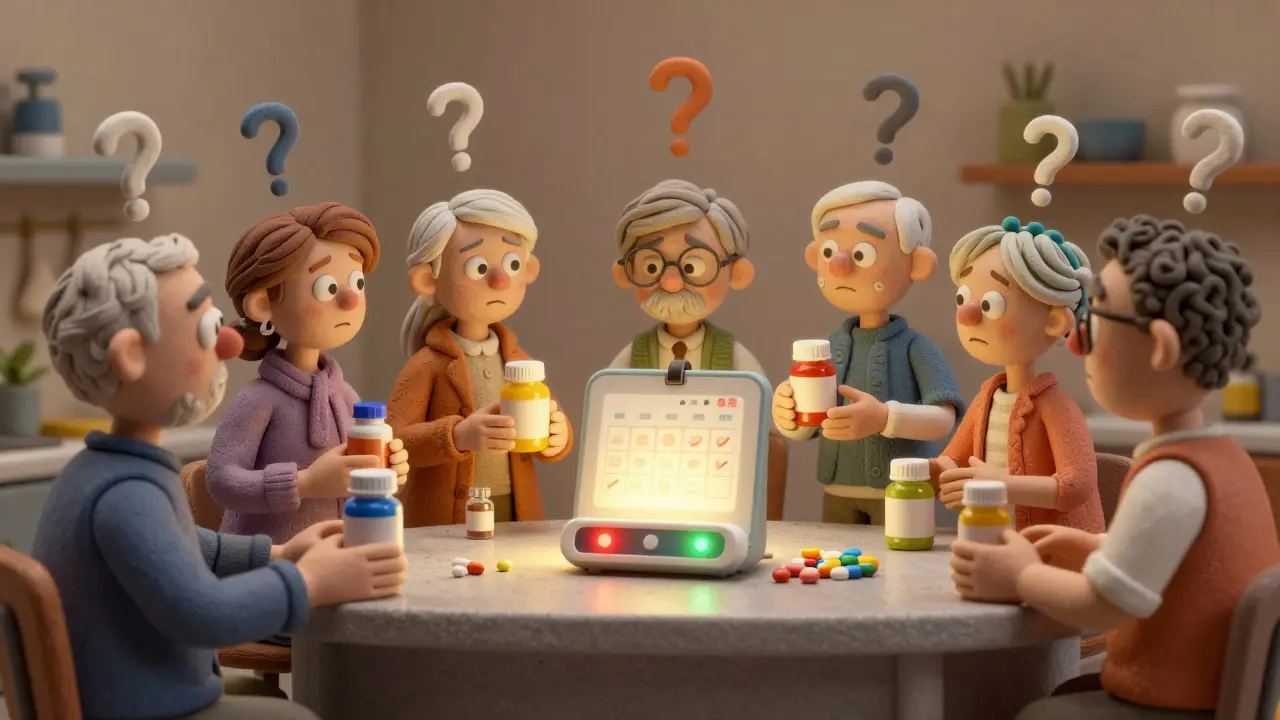
When you fill a prescription for a generic drug, you’re saving money - but are you taking it? For millions of people managing chronic conditions like high blood pressure, diabetes, or asthma, generic medications are the backbone of treatment. Yet, nearly half stop taking them within a year. Why? Cost isn’t always the issue. It’s forgetfulness, complexity, or just not feeling sick enough to bother. And because generics lack the marketing muscle of brand-name drugs, they’ve long been left out of adherence programs. That’s changing. Digital tools are stepping in to fill the gap - not with flashy ads, but with real data, smart packaging, and systems that actually track whether a pill was taken.
Why Generic Medications Need Special Attention
Generic drugs make up 90% of all prescriptions in the U.S., according to the Association for Accessible Medicines. They’re just as effective as brand-name versions, but they cost 80-85% less. That’s why insurers and pharmacies push them. But here’s the problem: patients are less likely to stick with generics. Studies show people on multiple generics are 30% more likely to quit taking their meds than those on brand-name drugs. Why? It’s not about quality. It’s about perception. When a pill looks different each time you refill - different color, shape, or size - your brain doesn’t recognize it as the same medicine. That confusion leads to skipping doses. And when you skip doses for conditions like heart disease or epilepsy, the consequences aren’t just inconvenient - they’re life-threatening.That’s where digital adherence tracking comes in. These aren’t simple phone reminders. They’re systems built to verify actual ingestion. The goal? Turn guesswork into data. And that data can save lives - and money. The U.S. healthcare system loses $300 billion a year because people don’t take their meds as prescribed. A big chunk of that comes from non-adherence to generics.
How Digital Tools Actually Track Your Pills
There’s more than one way to know if someone took their pill. And not all methods are created equal.Smart pill bottles like those from AARDEX Group’s MEMS AS system use tiny electronic caps that log every time the bottle is opened. The system doesn’t just record when you opened it - it uses 70+ algorithms to estimate whether you actually took the dose based on timing, frequency, and patterns. It’s the gold standard in clinical trials, with claims of 100% accuracy. But it’s designed for research, not daily use. It doesn’t talk to you. It doesn’t nudge you. It just records.
Smart pill dispensers like the Tenovi Pillbox are built for real life. It’s a box with compartments for each dose, and LED lights that glow red if you haven’t taken your pill yet, green if you have. It connects via cellular network, so even if you don’t have Wi-Fi, it still sends data to your doctor. It tracks up to four medications at once and syncs with EHRs like Epic and Cerner. A 2022 case study found that patients on hypertension generics improved adherence by 28% using this system - far better than phone alerts alone. But it costs $149 upfront, plus $30 a month. Not everyone can afford that.
Electronic blister packs from Wisepill Technologies work like a vending machine for pills. Each blister is sealed and only releases when it’s time to take the dose. The pack logs every opening and sends alerts if you miss a dose. It’s been used successfully in tuberculosis treatment, where missing a dose can lead to drug-resistant strains.
Video monitoring - yes, really - is another method. Systems like VDOT let patients record themselves taking their medication. A 2022 study showed 95% adherence in TB patients using this method. But it requires trust, time, and privacy. Many patients quit after a few weeks because it felt like being watched.
And then there are the apps. Thousands of them. But a 2022 review found only seven met basic quality standards. Most just send reminders. They don’t verify. They don’t connect to doctors. They’re digital Post-its - easy to ignore.
What Works Best - And What Doesn’t
Let’s cut through the noise. Not all digital tools are worth your time.For complex regimens (5+ meds, multiple times a day), systems like Tenovi and Wisepill win. They physically control access to the medication. You can’t skip a dose if the pill doesn’t come out. A 2023 study of heart failure patients showed a 41% reduction in hospital readmissions when using these systems.
For pharmacies, tools like McKesson’s APS dashboard are useful. They analyze refill patterns to flag patients who aren’t picking up meds. But here’s the catch: refill data isn’t the same as actual use. Someone could refill a prescription and still not take the pills. One pharmacist in Ohio told us their diabetes adherence rate jumped from 62% to 78% using McKesson - but only after hiring a full-time tech to manage the system.
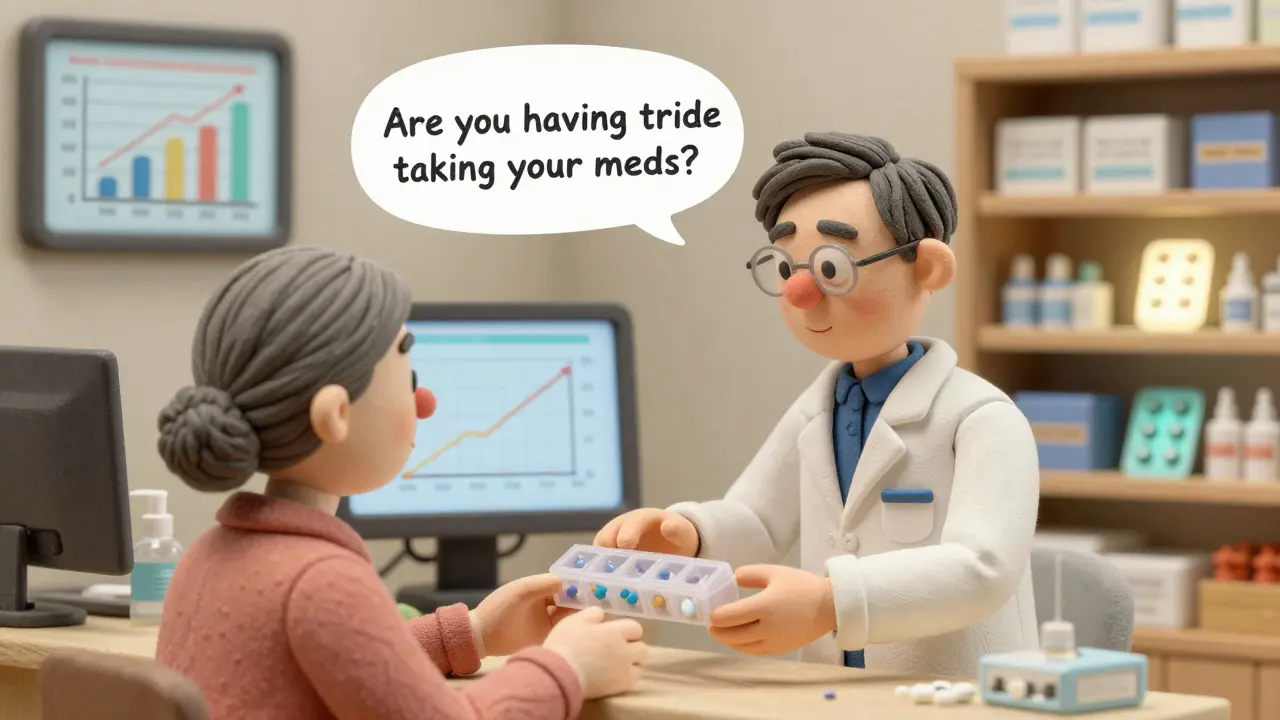
For low-income patients, the most effective solution isn’t a fancy device. It’s a pharmacist. A 2022 AHRQ study found that when pharmacists spent just 3-5 minutes during pick-up asking, “Are you having trouble taking your meds?” and offering a simple solution - like a pill organizer - adherence improved by 35%. Sometimes, the cheapest tool is the most powerful one.
On the flip side, MEMS AS - despite its accuracy - isn’t practical for everyday use. It’s expensive, bulky, and doesn’t engage the patient. It’s great for trials, but not for your grandma taking her blood pressure pills.
Real-World Challenges: Privacy, Cost, and Burnout
It’s not all smooth sailing. Real people using these tools report real problems.One Tenovi user on Amazon wrote: “The cellular gateway dies every three days with four medications tracked.” Battery life is a hidden issue. If the device dies, the data stops. And if the data stops, your doctor can’t help.
Another common complaint: intrusiveness. Patients on PatientsLikeMe said the constant LED lights and notifications felt “invasive.” One 72-year-old woman with hypertension said, “I don’t need a box telling me when to take my pills. I need quiet.”
Then there’s cost. Only 38% of Medicare Advantage plans cover remote therapeutic monitoring as of late 2022. That means most seniors pay out of pocket. At $149 + $30/month, it’s not sustainable for fixed-income users.
And privacy? A 2022 AHRQ survey found 63% of patients worried about who sees their adherence data. Will insurers raise premiums? Will employers find out? No laws clearly say “no.” That fear alone stops adoption.
The Future: AI, Integration, and Real ROI
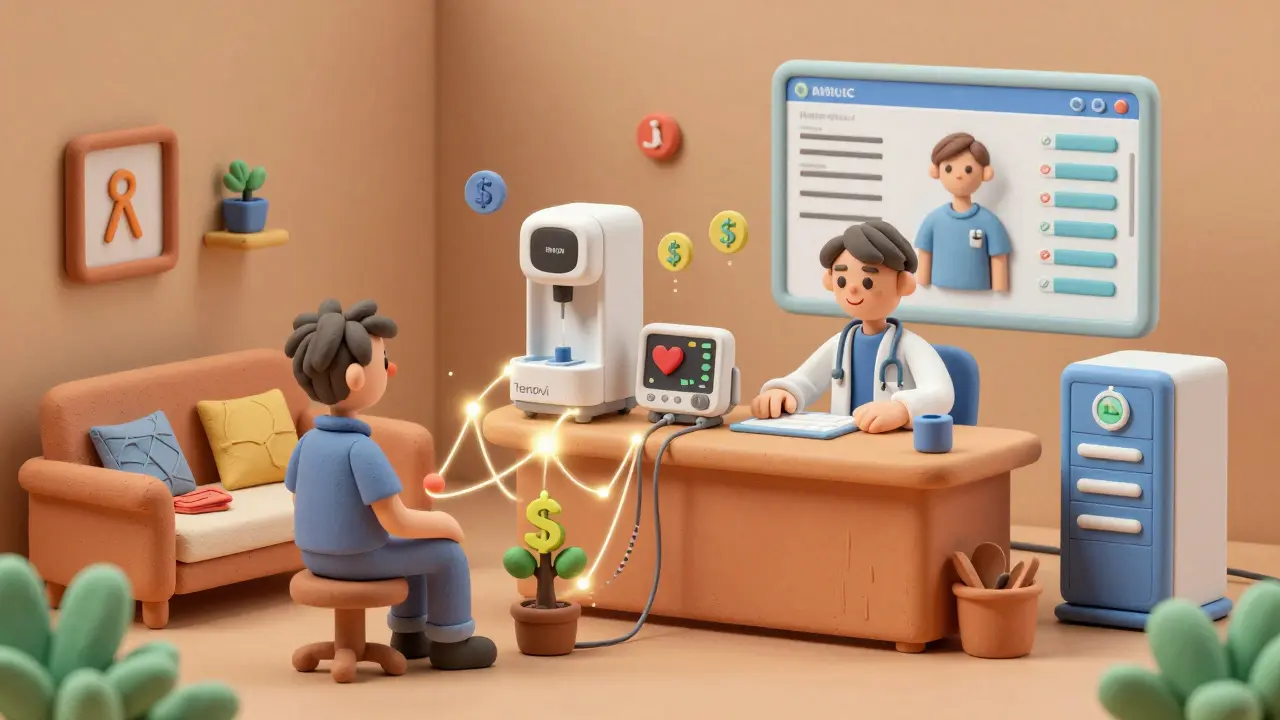
The field is evolving fast. In March 2023, AARDEX released MEMS AS version 5.2 with new algorithms specifically tuned for generic medication patterns. Tenovi added direct EHR integration with 12 major systems. CVS Health ran a pilot using machine learning to predict which patients were at risk of stopping their meds - and it cut non-adherence by 22%.But the real breakthrough isn’t the tech. It’s the evidence. A 2022 study in the New England Journal of Medicine Catalyst found that for every $1 spent on adherence programs for cardiovascular generics, healthcare systems saved $7.20. That’s a return most insurers can’t ignore.
By 2025, experts predict only 3-5 major platforms will dominate - not because they’re the flashiest, but because they’re integrated into pharmacy benefit systems. Imagine this: your pharmacy automatically knows you missed two doses. They text you. Then they call. Then they send a free pill organizer. No device needed. Just data, empathy, and action.
What You Can Do Today
If you or someone you care for is on generics and struggling to stay on track:- Ask your pharmacist: “Do you have any tools to help track medication use?”
- Try a simple pill organizer with alarms - even a basic one can help.
- Use your phone’s calendar or reminder app - but pair it with a physical check (e.g., “Did I take it? Put the empty pill bottle in the trash.”)
- If you’re on multiple meds, ask about electronic blister packs or smart dispensers - some pharmacies offer them at low or no cost through pilot programs.
- Don’t assume your doctor knows you’re skipping doses. Tell them. They can’t fix what they don’t know.
Adherence isn’t about willpower. It’s about design. The right tool removes friction. It doesn’t nag - it supports. And for generics, that support is long overdue.
Do digital adherence tools really work for generic medications?
Yes - but not all tools are equal. Systems that physically control pill access (like smart dispensers or electronic blister packs) show the highest adherence rates, especially for chronic conditions. Studies show improvements of 25-40% when using these compared to basic reminder apps. The key is verification, not just reminders. Tools like Tenovi and Wisepill have demonstrated real-world results in trials for hypertension, heart failure, and asthma.
Are these tools covered by insurance?
Mostly no. As of late 2022, only 38% of Medicare Advantage plans covered remote therapeutic monitoring devices. Private insurers vary widely. Some pharmacy chains offer free or low-cost devices through pilot programs. Always ask your pharmacist or insurer directly - coverage is changing fast as evidence of cost savings grows. The CDC and CMS are now tracking adherence metrics more closely, which may lead to broader reimbursement by 2026.
Can I use a regular pill organizer instead?
A basic pill organizer helps - but it doesn’t track. If you forget to take your pill, it won’t notify your doctor. If you take it early, there’s no record. For mild adherence issues, it’s fine. But if you’re on 3+ daily medications, have a history of missed doses, or have a chronic condition like diabetes or heart disease, a digital tracker that logs actual use gives you and your care team real insight. It’s like having a second pair of eyes.
What’s the cheapest way to improve generic medication adherence?
Talk to your pharmacist. A 2022 AHRQ study found that just 3-5 minutes of direct conversation during medication pickup - asking, “Are you having trouble taking your pills?” - improved adherence by 35%. Many pharmacies now offer free pill organizers, refill reminders, or even home delivery. No tech required. Just human connection.
Is my adherence data safe?
It depends on the system. Clinical-grade tools like MEMS AS and Tenovi follow HIPAA and encrypt data. Consumer apps often don’t. A 2022 review found 78% of medication apps failed to clearly explain how data was used or shared. Always ask: “Who owns this data? Can my insurer see it? Can I delete it?” If they can’t answer, choose something else. Your health data should be private - not a marketing tool.


